
Are you looking to:
- explore today’s most pressing global challenges in both academic and practical ways?
- better understand the international developments shaping society, work, and your future field?
- connect with students from different backgrounds who are interested in sustainability, social impact, and global cooperation?
- strengthen your profile by adding an international and global perspective to your main studies?
Beyond Borders is a minor that helps you make sense of these developments and learn how to work with them. You explore global issues through hands-on projects, an international or local internship, and a study trip to an European capital.
Admission
A minimum English proficiency level of B1 (CEFR) is required to participate in this minor.
The Examination Board determines which minors do not have a higher professional education level and/or have an unacceptable overlap with the compulsory curriculum of your own study programme. Check at the page Not allowed minor courses under your institute which minors are not allowed.
Content
Interactive learning
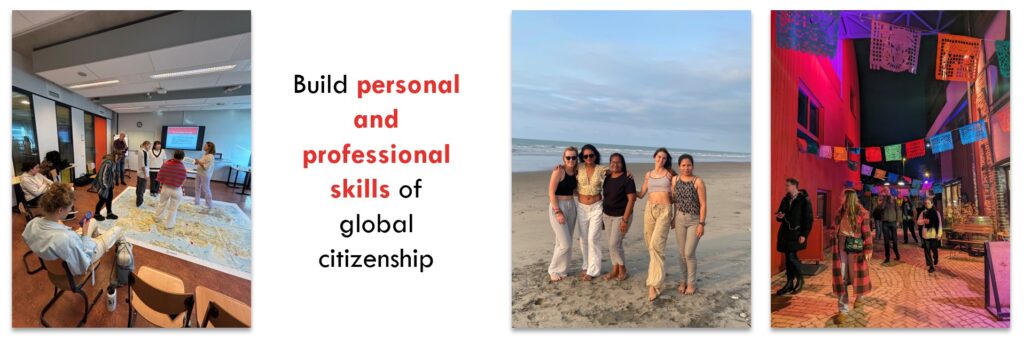
You work together with students from various study programs and international backgrounds: in previous years, our students have come from countries such as Japan, Ghana, the UK, Ireland, Germany, Spain, and Italy. Classes include workshops, guest lectures, and group projects that bring theory to life.
Challenge-based learning
You and your team take on a real-life issue and design a solution that can be applied in practice.
Study trip
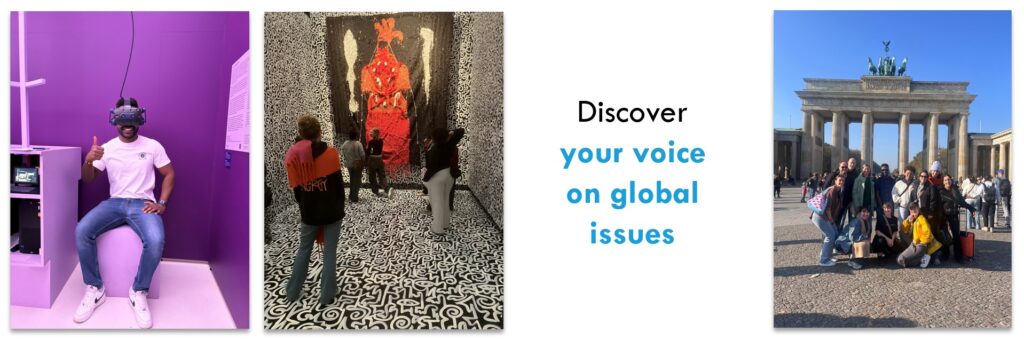
You visit a European city rich in history and international influence. You plan the trip together with your fellow minor students, making the trip engaging, creative, and collaborative.
Internship
You choose a placement that fits your interests, your study background, and the kind of impact you want to explore. The possibilities are broad. Some examples from previous minor cohorts include:
International internships:
- Greece
Because We Carry – supporting refugee mothers with children on Lesvos - Ecuador
A Mano Manaba Foundation – empowering children in rural communities through education and creative activities - Germany
Youth Court Cologne – assisting with youth justice and social support - Across the Netherlands, students have interned at organizations such as:
-
- Detective squad in Rotterdam South
- Refugee and asylum seeker centers
- Utrecht University Green Office (sustainability projects)
- Cross Your Borders educational programs in schools
- Local sustainability projects, e.g. community gardens
- Food banks and neighborhood support projects
- Organizations supporting elderly and disabled communities
- And many more…
Learning objectives
During the minor, you will:
- explore the meaning of global citizenship in personal and professional contexts
- understand how globalization, nationalism, technology, media, and religion shape society
- study inequality and human rights through real case studies
- learn to apply the UN SDGs in real-world situations
- join a study trip to a European city (previously Berlin) to explore real-world examples of global citizenship.
- complete a 7-week internship of approximately two days/week
- reflect on your growth during the minor and relate your experiences to your future career.
This minor is part of the Green Office’s Sustainable Minors initiative.
Courses and Assesment
Below is a clear overview of all course units:
| Module | Course Title | Focus | Assessment |
| A | The world around you | Introduction to global citizenship and your personal role in it | Presentation |
| B | Learning to live together | A historical perspective on global citizenship and its main themes | Research project, including excursion |
| C | Global inequality | Major global challenges viewed through a human rights lens | Biographical article + SDG video |
| D | Internship / traineeship | 7-week placement, approximately 2 days per week | Portfolio |
| E | Personal-professional development | Reflect on your growth and future professional direction with a biography | Biography + interview |
| F | Global challenges | Challenge-based learning group project | Group presentation + design of a prototype |
The minor is offered twice per academic year, beginning in Block A and in Block C.
Literature
All course materials will be provided through the Canvas learning environment.
There are no mandatory books that students need to purchase for this minor.
Schedule
Full-time: Thursday 9.30 to 17.00, Friday 9.00 to 13.00
Part-time: Thursday 9.30 to 17.00
With the exception of the first teaching period of the academic year (starting September), the lesson and test schedules are always posted on Mijn Rooster four weeks before the start of each teaching period. The schedule for the first teaching period of the academic year can be found on the site three weeks before the start. The most up-to-date schedule is always visible on Mijn Rooster.
At HU, full-time education may be scheduled between 08:30 and 19:00.
Additional costs
Estimated 350 EUR for the international study trip (EU destination).
Financial support
You can contact the HU Erasmus+ team (erasmus@hu.nl) to check whether you qualify for financial support abroad through an Erasmus+ grant.
If you are a student from a university other than HU, contact the international office at your institution to inquire about short-term Erasmus+ mobility grants.
Reviews
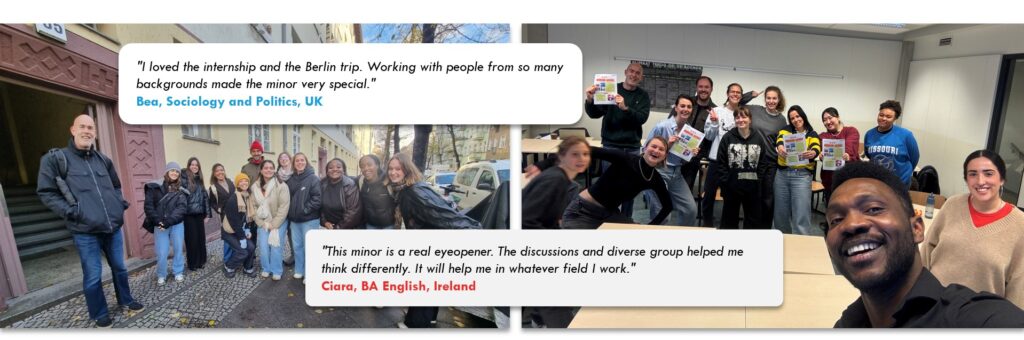
“This minor is a real eyeopener, it has broadened my view. The topics are very relevant and important for everyone. It is good to learn in a small group with students from all sorts of backgrounds and from different countries. We have many discussions and arguments about issues like human rights and sustainability. Learning in this minor is quite interactive and centered around discussion. I was not used to that, as my study in English is based on lectures. But I find it very useful, it makes you really think about the topics. This minor will help me in whatever area I will work.”
Ciara, student BA English, Waterford College of Further Education, Ireland, age 21
“This minor was quite different from what I expected, normally I have lectures. The minor is very interactive, we worked in small groups on a great number of subjects. It was educational to be able discuss very openly with people with such different backgrounds and views.
For me the internship was the best thing of this minor. It was the first time I did an internship. I worked in a refugee charity centre and I learned a lot, also about Dutch culture. I still work there as a volunteer now, to provide activities to children and give English classes.
Our trip to Berlin was really cool, each of us had to create a day out for everyone and we learned about Berlin as a global city. But in general the minor was a bit too easy for me and I would have liked more structure.”
Bea, student Sociology and Politics, Durham University, age 21