
In our Smart Sustainable Cities (SSC) programme, you will work with an international group of fellow students and lecturers on designing sustainable cities for the future. How do we solve problems related to energy, mobility and waste in the city? How do we create healthy, inclusive cities, where citizens are actively involved? These questions challenge us to develop integrated smart sustainable solutions for economic, social and environmental problems. Our future depends largely on whether we’ll be able to boost the sustainable development of cities. So join the SSC minor programme and become the smart sustainable city professional of the future!
Admission
This multidisciplinary minor is open to all students who are interested in the development of smart sustainable cities. Everybody is welcome with the right motivation, your previous education could be related to sustainability, engineering, IT, social studies, communication, business or design.. Apart from that there are no formal admission requirements, but you are expected to have attained English CEFR level B2.
This minor is only suitable for fulltime students.
The Examination Board has already determined which minors do not have a higher professional education level and/or have an unacceptable overlap with the compulsory curriculum of your own study programme. Check at the page Not allowed minor courses under your institute which minors are not allowed.
Content
As more and more people around the world live in cities, it is important we change our cities’ dependence on non-renewable energy, that we limit the use of (building) materials that are not part of a closed cycle. Cities need to provide a healthy living environment for all citizens, with affordable and accessible mobility.
To do this, we need to find and implement sustainable solutions that can easily fit in with the ways in which people live and you can be part of that process! During the programme, you combine regular course work with a project assignment from real life clients.
Going abroad
During this minor you will get the unique opportunity to go abroad for a short period. You will work on one of the ‘Sustainability Challenges’ for clients Netherlands or abroad. The project locations abroad may differ per year. Past projects abroad took place in e.g. Valencia (Spain), Turku (Finland), Manchester (UK) and Bochum (Germany). The costs for travel and accommodation are for your account. Students that have a full-time registration at HU may be eligible for ERASMUS+ short term mobility funding.
Learning objectives
You work on the analysis of Smart Sustainable Cities (SSC) challenges, the design of SSC solutions and the evaluation of their feasibility. These sustainability challenges are complex but reasonably structured, the available methods are known, the context is multidisciplinary and situated in practice, and coaching supervision is available.
After successfully completing this course, you can:
- analyze a given urban situation in terms of community needs, (built) environment and processes;
- propose hands-on, innovative, smart, creative and viable solutions and recommendations;
- apply a set of analytical, design and project management skills and the knowledge gained from instructions and workshops;
- work successfully in an interdisciplinary and international team, comparing, analyzing and combining your own and others’ ideas and solutions;
- develop communicative skills (presenting, writing, discussing) , and personal/professional skills for life-long learning (reflection skills, personal development plan, critical thinking)
- critically evaluate the quality of the solutions proposed
Courses
The programme consists of a 15 EC Introductory Course and a 15EC multidisciplinary ‘Sustainability Challenge’. In the Introductory Course you will learn more about energy, mobility, circular economy and healthy urban living in various workshops and excursions, and you’ll learn how to apply relevant methods and techniques for researching, designing and advising on/about Smart Sustainable Cities.
During the Sustainability Challenge, you work independently with your team on behalf of a real client (for example the municipality). In this challenge your are supported by a tutor and experts. You will explore the sustainability challenge that they are facing, you will design smart, creative, innovative and viable solutions for this challenge. You are of course also responsible for project management.
Assessment
Assessment takes place through:
- Test
- Research plan
- Reflection report
- Final report
- Presentation
Literature
Rietbergen, M.G., R. van Stigt, E-J. Velzing (2021). Smart Sustainable Cities – a handbook for applied research. HU University of Applied Science Utrecht, Utrecht, The Netherlands. ISBN: 9789089281494. All other literature is made available through the digital learning environment.
Schedule
The schedule and the days are not yet known. The Introductory Course will take place about three days a week, the Sustainability Challenge is scheduled for about two days a week. There are no online classes. Only for students who choose to go abroad during the Sustainability Challenge, online classes can be arranged.
With the exception of the first teaching period of the academic year (starting September), the lesson and test schedules are always posted on Mijn Rooster four weeks before the start of each teaching period. The schedule for the first teaching period of the academic year can be found on the site three weeks before the start. The most up-to-date schedule is always visible on Mijn Rooster.
At HU, full-time education may be scheduled between 08:30 and 19:00.
Additional costs
Around € 500 if you go abroad. Students registered at HU may be eligible for Erasmus support for short term mobility.
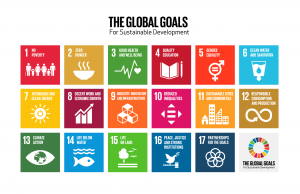
This minor course is marked by the Green Office as a sustainable minor. This means that by participating in this minor course, you can contribute to one or more of the Sustainable Development Goals from the UN.
Reviews
“A wonderful minor! Beforehand I expected the Dutch university system to be better than the Hungarian, but this minor even exceeded my expectiations. The teachers really cared about their subjects and they helped us on a personal and a professional level. I am specializing in energy and I would like to find a job in the sustainable energy sector.
The best part of the minor for me was the project. I never took part in such projects before, as the Hungarian university system is focussed on theoretical knowledge. But during the project of this minor we would also apply our knowledge in practice. Our group had students with lots of different backgrounds. I really liked the atmosphere. The discussions were very inclusive and meaningful, we were reflecting together and created bonds.”
Greg, student Electrical Engineering, University of Debrecen, Hungary, age 21